
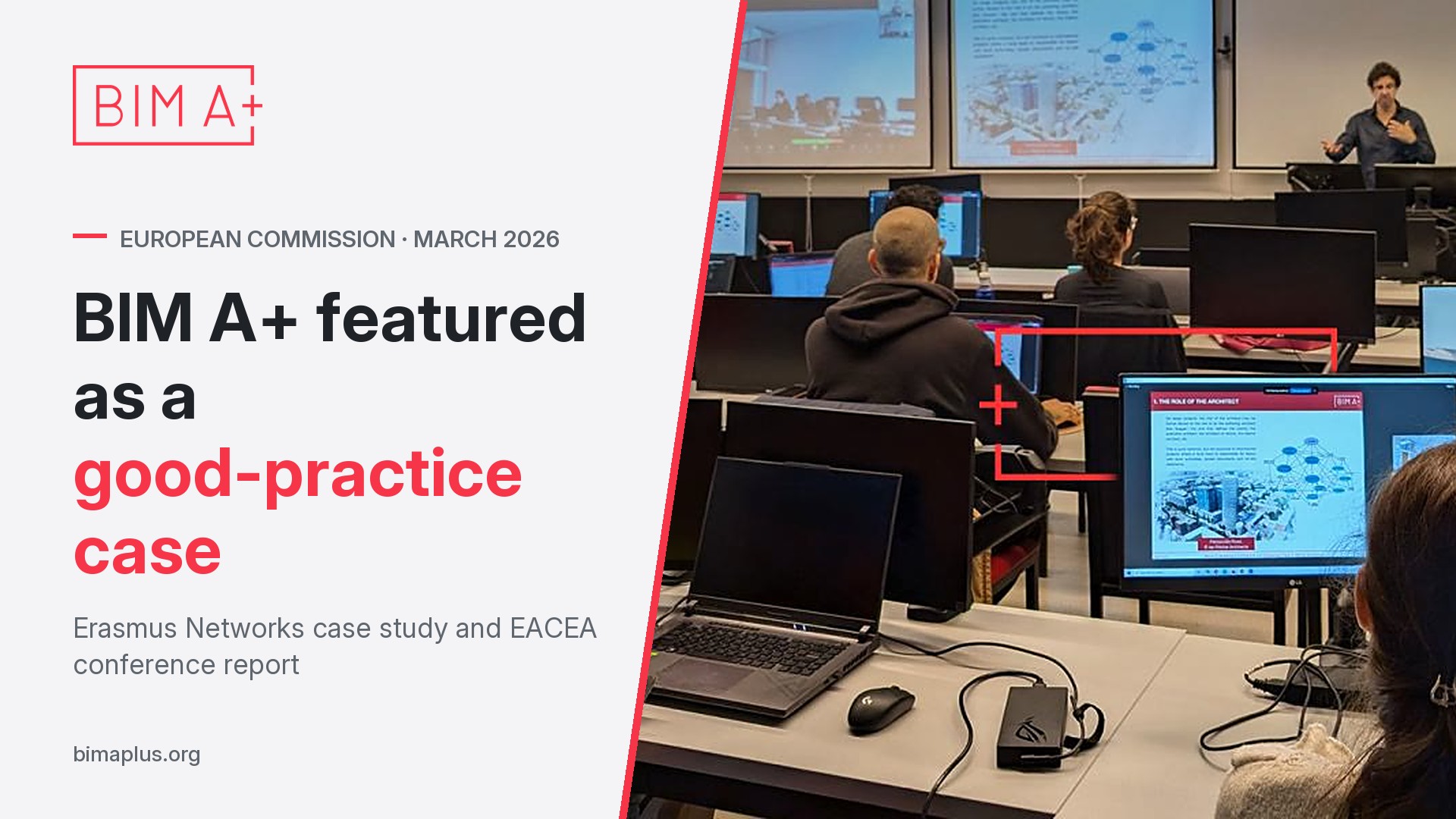
BIM A+ featured as a good-practice case by the European Commission
In November 2025, BIM A+ was invited to the Erasmus Mundus Annual Conference in Brussels to share how the programme has continued to thrive after its Erasmus Mundus funding period. Two European Commission publications now present BIM A+ as an example for other joint programmes.
A case study on the Erasmus Networks platform. BIM A+: Building Sustainability Through Creative Solutions, featuring insights from Prof. Miguel Azenha, describes how the programme adapted through creative solutions, strong industry alignment and a clear focus on quality, while continuing to attract around 700 applications each year.
A good-practice section in the official conference report. The 2025 Erasmus Mundus Annual Conference Report: The Sustainability of Erasmus Mundus Joint Master’s Programmes, published by EACEA, includes BIM A+ as one of two good-practice presentations on academic quality and talent attraction. The report highlights:
- BIM as a transversal competence across architecture and engineering, which attracts a broad and diverse group of students;
- the one-year format, which reduces opportunity costs for students and speeds up their return to professional practice, particularly for experienced professionals and self-funded students;
- dissertations developed with companies, mostly during the second-semester mobility;
- a simplified joint model: students pay fees locally while admissions, standards, integration activities and communication remain joint;
- continuous curriculum renewal, supported by staff involvement in national and European expert bodies;
- public dissertations, recorded student presentations, alumni engagement and the annual online conference as part of the programme’s quality and visibility.
We are grateful to the European Commission and EACEA for the opportunity to share our journey.
- Read the case study: https://erasmus-networks.ec.europa.eu/emc/bmia%2Bbuildingsustainability
- Read the conference report: 2025 Erasmus Mundus Annual Conference Report (PDF), section 5.1.1